
India's Northeast is a world apart. Eight states connected to the mainland by a narrow corridor, each with its own languages, cuisines, traditions, and landscapes. Despite being part of India, the Northeast feels like a different country. It is also one of the most underrated travel destinations in all of Asia. Here is why it needs to be on your list.
Meghalaya: Living Root Bridges and the Wettest Place on Earth
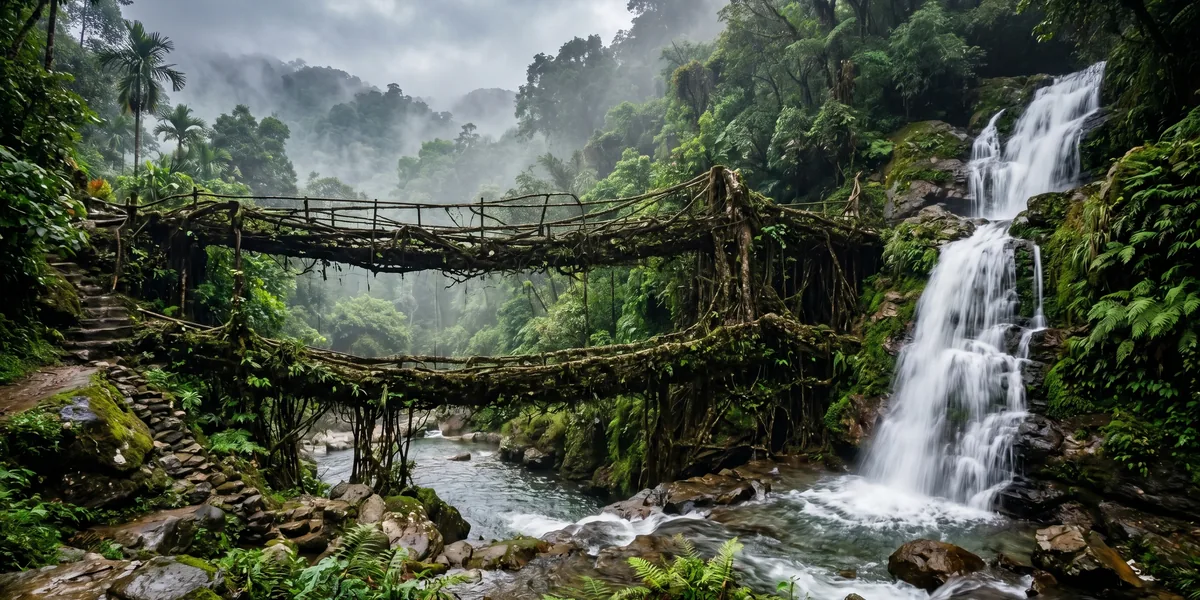
The Khasi and Jaintia hills of Meghalaya are home to something found nowhere else on the planet: living root bridges. These are functional bridges grown from the aerial roots of rubber fig trees over decades, sometimes centuries. The most famous is the double-decker root bridge at Nongriat, which requires a trek of about 3,000 steps down into a valley. The village of Mawlynnong, often called the cleanest village in Asia, is nearby. Cherrapunji (Sohra) and Mawsynram receive the highest rainfall on Earth, creating hundreds of waterfalls during monsoon season.
Assam: Kaziranga and River Island Culture
Kaziranga National Park in Assam is home to two-thirds of the world's one-horned rhinoceros population. An early morning elephant safari through the tall grass offers one of the best wildlife experiences in India. Beyond Kaziranga, the Brahmaputra river island of Majuli is the world's largest river island and a centre of neo-Vaishnavite culture. The satras (monasteries) here preserve ancient dance, music, and mask-making traditions. Majuli is slowly eroding due to floods, making a visit both urgent and meaningful.
Arunachal Pradesh: Tawang and Beyond
Arunachal Pradesh requires an Inner Line Permit for Indian citizens and a Protected Area Permit for foreigners. The journey to Tawang takes you over Sela Pass at 4,170 metres, through cloud forests, past waterfalls, and into a town dominated by the Tawang Monastery, the largest Buddhist monastery in India and second largest in the world after Lhasa. The monastery houses priceless manuscripts, thangka paintings, and a 28-foot golden Buddha statue. The town also serves as a gateway to remote areas like Zemithang and Lumla near the Myanmar border.
Dawki: Crystal-Clear Waters
The Umngot River at Dawki on the India-Bangladesh border has become famous for its impossibly clear water. Boats appear to float in mid-air. The best time to visit is between October and March when the water is at its clearest. From Dawki, you can also visit the living root bridge at Riwai and the natural rock formations at Mawjymbuin Cave. The border town atmosphere adds its own flavour, with Bangladeshi markets visible across the river.
Local Cuisine
Northeastern cuisine is a revelation for most Indian travellers. Naga cuisine features smoked pork with bamboo shoot, fermented soybean chutneys, and the intensely hot Naga King Chilli (Bhut Jolokia). Manipuri dishes like eromba (fermented fish and vegetable stew) and chak-hao kheer (black rice pudding) are unique to the region. In Meghalaya, try jadoh (red rice cooked with pork) and tungrymbai (fermented soybean). Assamese cuisine offers duck meat curry with ash gourd and khar made with banana peel ash.
Permit Requirements
Indian citizens need an Inner Line Permit (ILP) for Arunachal Pradesh, Nagaland, Mizoram, and Manipur. These can be obtained online or at entry points. Meghalaya, Assam, Tripura, and Sikkim do not require ILPs for Indian nationals. Foreign tourists need a Protected Area Permit for Arunachal Pradesh and a Restricted Area Permit for parts of other states. Processing takes 2-4 weeks for foreigners, so plan ahead.
Getting There and Getting Around
Guwahati is the main gateway, well-connected by flights and trains from all major Indian cities. From Guwahati, Shillong is just 3 hours by road, and Kaziranga is about 4 hours. Reaching Tawang from Guwahati takes a full two days by road with an overnight stop at Bomdila or Dirang. Internal flights connect Guwahati to Imphal, Dimapur, Aizawl, and Agartala. Shared Sumo taxis are the most common mode of inter-city transport within the region.
The Northeast does not just offer beautiful landscapes. It offers a completely different way of experiencing India, where tribal traditions coexist with modern aspirations and where the concept of hospitality takes on deeper meaning.
If you have done the Golden Triangle and the Goa-Kerala-Rajasthan circuit, the Northeast is your natural next step. It will challenge your assumptions about India and reward you with experiences you simply cannot find anywhere else in the country.